• Global CNC market projected to reach $128B by 2028 • New EU trade regulations for precision tooling components • Aerospace deman
NYSE: CNC +1.2%LME: STEEL -0.4%

How Smart Manufacturing Technology Improves OEE Across Industry 4.0 Production Lines
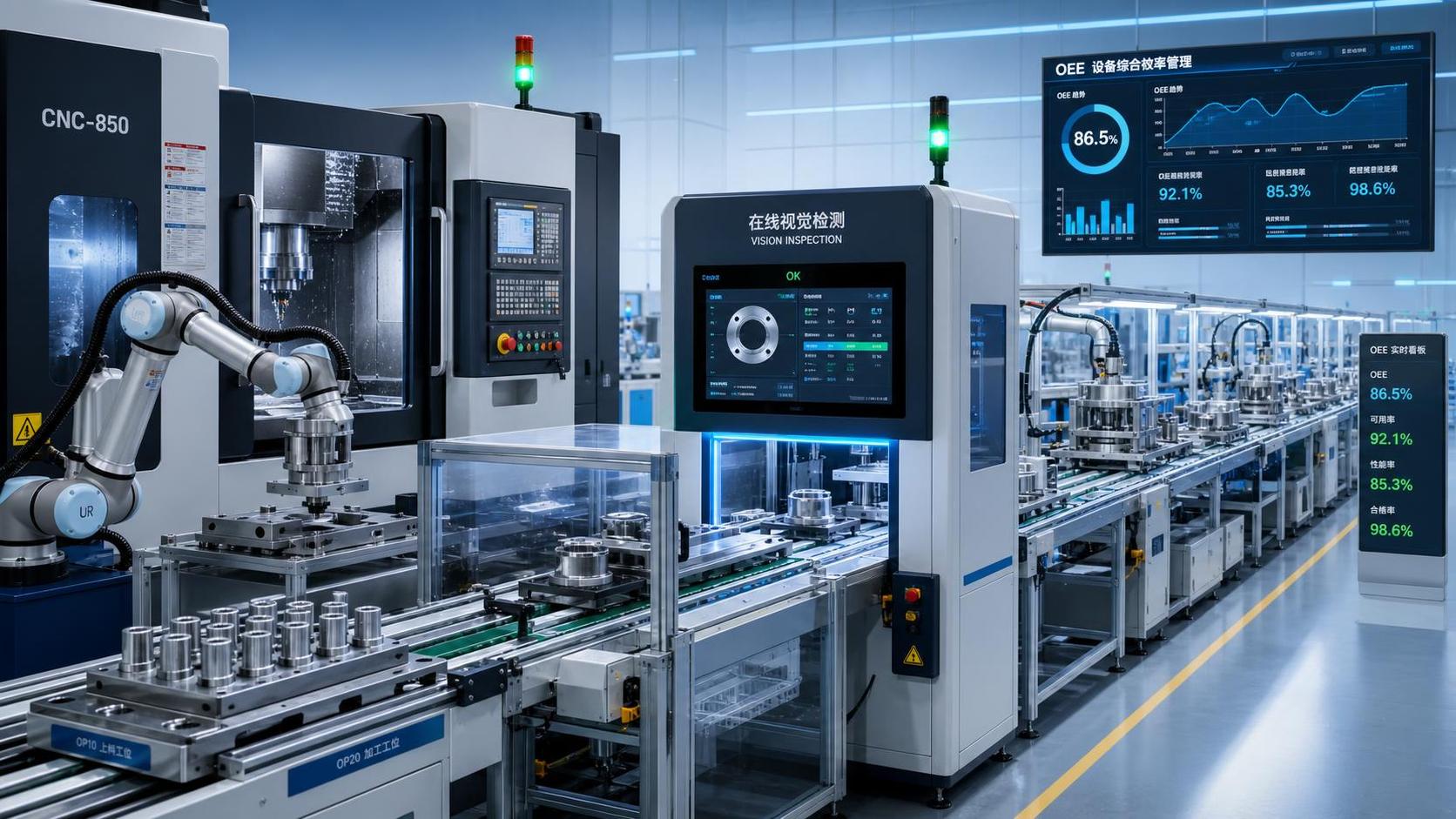
OEE improvement is no longer a machine-level problem
For project managers responsible for CNC cells, automated assembly lines, or mixed-model production environments, overall equipment effectiveness is often discussed as a simple calculation: availability multiplied by performance multiplied by quality. The formula is familiar. The operational reality is not.
A production line can report acceptable machine uptime while still missing output targets because operators wait for material, a robot cell pauses for confirmation, programs are adjusted too often, or inspection feedback arrives after a batch has already moved downstream. In that situation, the issue is not merely whether a CNC machine is running. It is whether the entire production system is converting scheduled time, labor, materials, and equipment capacity into conforming parts at the required pace.
This is where Smart Manufacturing Technology for Industry 4.0 becomes relevant. Its value is not that it places more screens, sensors, or dashboards on the shop floor. Its practical role is to connect events that have historically been managed separately: machine status, tool condition, job scheduling, material flow, quality results, maintenance activity, and operator intervention. When these signals are connected with sufficient context, managers can identify the real causes of OEE losses and act before local inefficiencies become missed delivery commitments.
The technology is especially relevant in sectors with demanding tolerances and complex production routing, including automotive components, aerospace structures, energy equipment, precision electronics, and general industrial machinery. But it is not automatically appropriate for every factory. The strongest results tend to come from projects that begin with a defined operating constraint rather than a broad ambition to “digitize the factory.”
What project teams are actually trying to solve
When a manager searches for ways to improve OEE through smart manufacturing, the underlying question is usually more specific: where is usable capacity being lost, and can the organization recover it without adding more machines or labor?
In a CNC production line, availability losses may include spindle failures, hydraulic alarms, tool breakage, fixture problems, delayed setup approval, robot faults, network interruptions, or time spent waiting for maintenance. Performance losses are often less visible. A machining center may continue to show “running” status while operating below its expected cycle time because feeds were reduced, a tool path was modified, an operator added a manual check, or a part-handling system created small but recurring delays. Quality losses may be recorded only at final inspection, long after the machine and process conditions that produced the defect have changed.
Traditional OEE reporting can reveal that losses exist, but it does not necessarily explain their source or economic importance. A smart manufacturing approach should improve that diagnosis. The objective is to distinguish between a two-minute stop caused by a normal chip-removal cycle and a two-minute stop caused by an unstable tool-life model that disrupts several machines each shift. The first may be expected. The second may justify process engineering, tooling, maintenance, or software investment.
That distinction matters because many OEE programs fail through over-aggregation. A monthly OEE number can mask the fact that one high-value part family, one fixture type, or one night shift is driving most lost capacity. Conversely, a low OEE value does not always indicate poor management. High-mix, low-volume production, frequent engineering changes, and qualification work may legitimately reduce apparent utilization. The decision is not whether to maximize a universal percentage. It is whether the measured losses are controllable and meaningful for the production strategy.
How connected data changes the OEE conversation
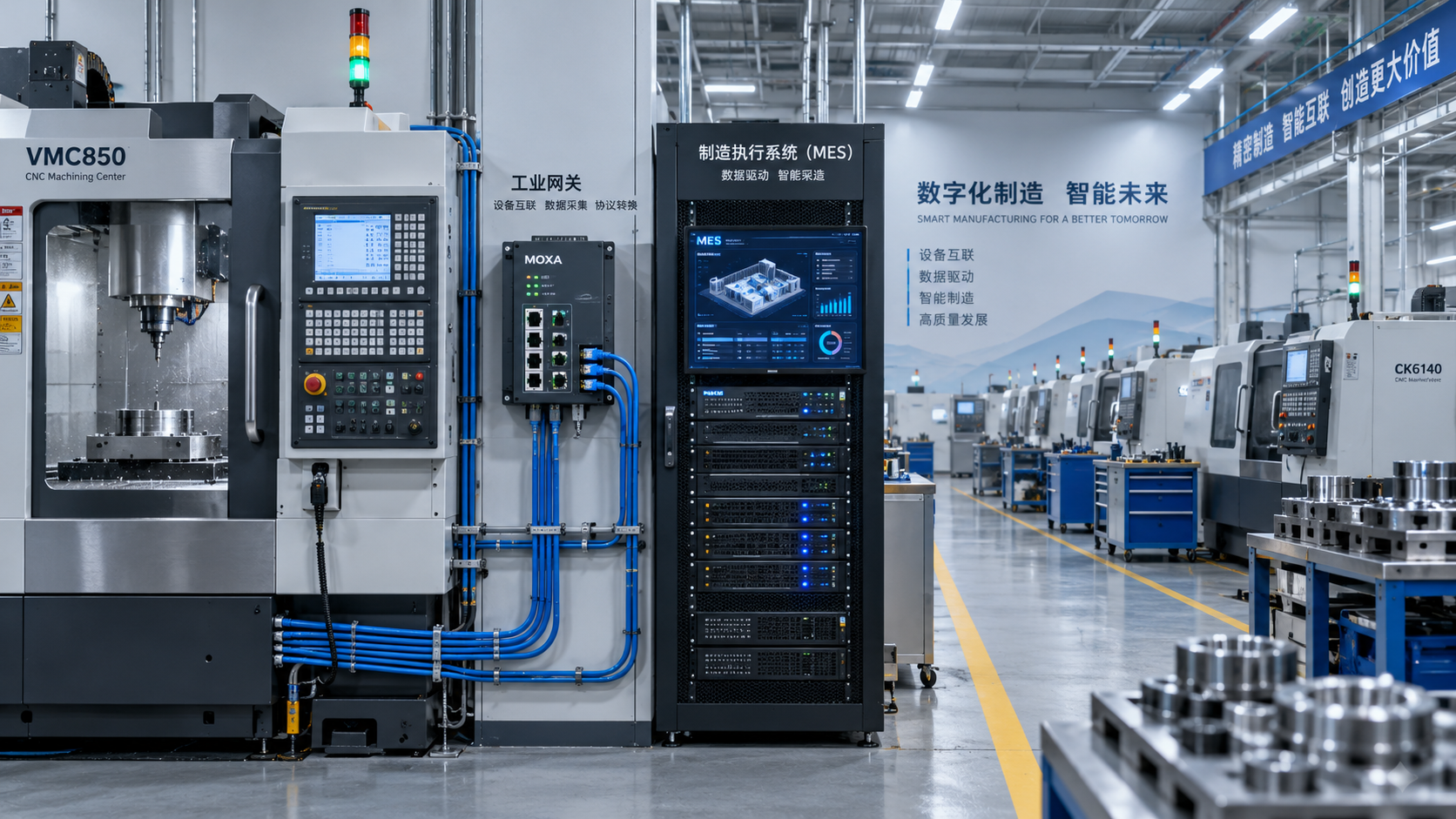
The core capability of Industry 4.0 production systems is contextual visibility. Data collection alone is insufficient. A machine controller can provide alarms, spindle load, feed rate, cycle state, and program information, but those data points need to be linked to work orders, part numbers, tools, operators, fixtures, inspection results, and maintenance records before they become useful for operational decisions.
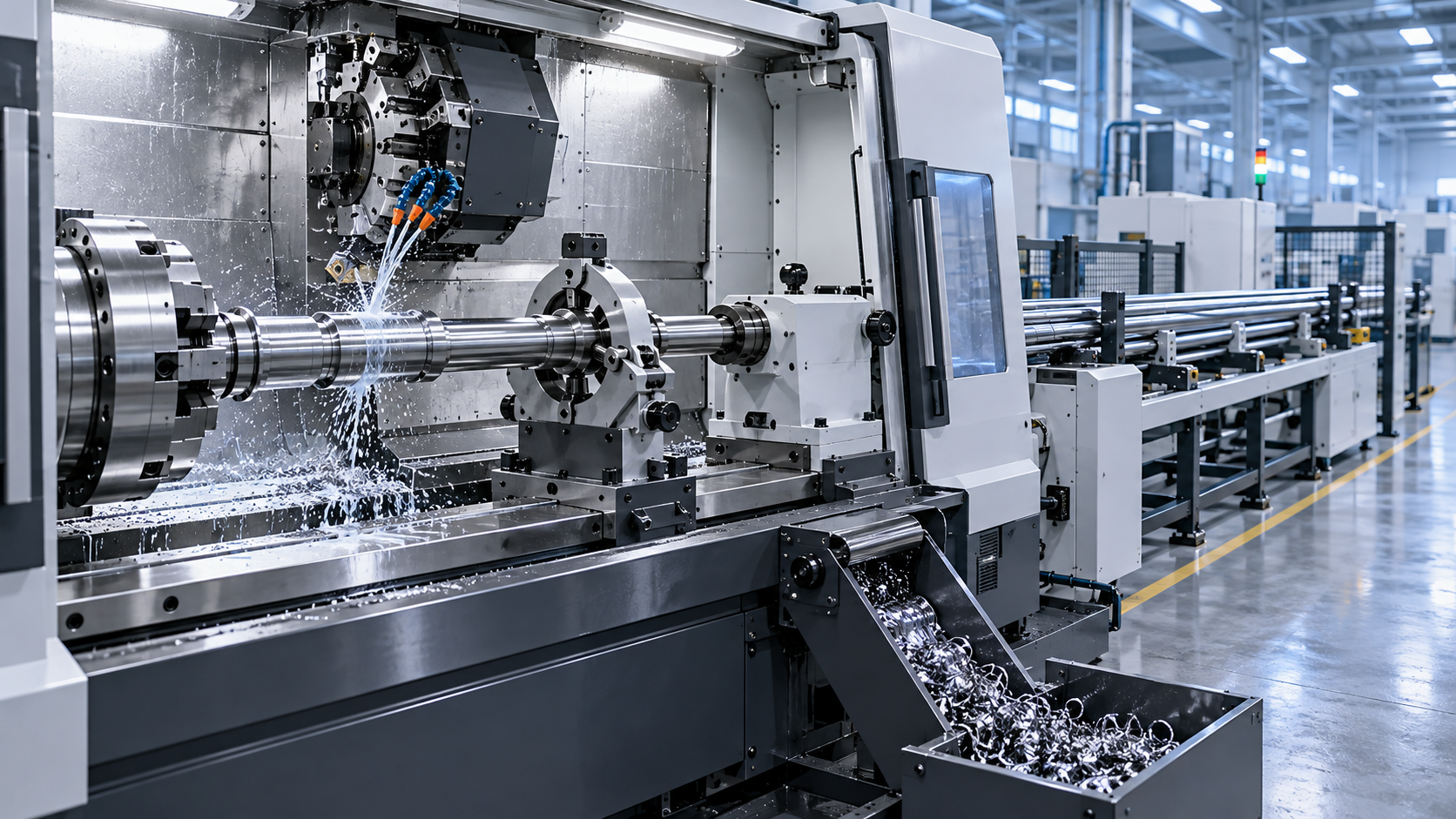
For example, consider a machining line producing precision shaft components. The manufacturing execution system may show that a cell is behind schedule. Machine connectivity indicates that the CNC lathe experienced repeated short stops. Tool-management data shows that stops occurred shortly after a particular insert lot was introduced. Quality data then reveals a rise in surface-finish variation on the same component. Without connection between these systems, each department may treat the event separately: maintenance sees alarms, production sees missed output, quality sees nonconforming parts, and purchasing sees a tooling issue. With a shared data model, the team can investigate the chain of events as one production problem.
That does not mean every plant needs a large centralized data platform before it can improve. In many cases, a focused deployment around a constrained line delivers clearer results than a multi-year enterprise program with vague ownership. The useful sequence is usually to capture reliable signals from priority assets, define common loss categories, connect those signals to operational context, and establish a routine for acting on the findings.
Availability: move from alarm response to planned intervention
Availability is often the first OEE component targeted because downtime is easy to recognize. Yet the category can become misleading when all stops are treated equally. Planned tool changes, scheduled preventive maintenance, and approved changeovers should not be analyzed in the same way as repeat servo alarms, unplanned fixture adjustments, or waiting time for a maintenance technician.
Smart manufacturing systems improve availability when they make downtime classification more accurate and less dependent on manual interpretation. Machine signals can initiate an event record; operators can confirm a reason through a simple terminal interface; maintenance systems can connect the event to a work order; and production planners can see whether the stop threatens the schedule. This creates a more defensible record than a generic “machine issue” entry completed at the end of a shift.
Predictive maintenance can add value, but it should be treated carefully. Condition monitoring is most useful when failure modes are understood and sensor data has a credible relationship to equipment health. Spindle vibration, temperature trends, motor current, hydraulic pressure, and axis performance can help detect degradation in certain assets. They do not eliminate the need for skilled maintenance judgment. A model that generates frequent warnings without clear action thresholds may create more disruption than benefit.
Project teams should therefore define what a prediction is expected to change. Can it shift maintenance into planned downtime? Can it prevent a known failure mode? Can it reduce spare-parts lead-time exposure? Can it protect quality-sensitive components? If the answer is unclear, collecting more condition data may be premature.
Performance: find the losses hidden inside “running time”
Performance losses are frequently the largest unaddressed OEE opportunity in connected factories. They are harder to see because the machine appears active. On a multi-axis machining center, the actual cycle may drift beyond the process plan because of conservative overrides, additional probing, chip accumulation, slower tool engagement, program edits, or robot synchronization delays. A line may lose only seconds per unit, but those seconds compound across large-volume production.
Real-time machine monitoring allows engineering and production teams to compare actual cycle behavior with the approved standard under comparable conditions. The comparison must be disciplined. A reported cycle-time deviation is only meaningful when the part revision, machining program, tool configuration, material condition, and production mode are known. Comparing a first-off part after setup with a stabilized run is not useful. Comparing the same part family across similar machines and shifts often is.
In practice, managers should look for recurring patterns rather than isolated deviations. Does a cycle slow after a certain number of parts? Does performance fall on one fixture? Are machine overrides routinely changed on a particular shift? Does an automated loading system cause micro-stops when product mix changes? These questions turn performance improvement into a structured engineering task instead of a broad instruction to “run faster.”
There is also a limit to cycle-time optimization. In high-precision applications, reducing seconds from a program may increase tool wear, dimensional variation, or scrap. The appropriate target is not the shortest theoretical cycle. It is the fastest stable cycle that meets process capability, safety, tool-life, and downstream quality requirements. This is why OEE projects should include manufacturing engineering and quality leadership, not only production supervision.
Quality: close the feedback loop before defects travel
Quality is the OEE component most likely to expose the weakness of disconnected operations. If a dimensional defect is identified only at final inspection, the reported rejection rate may be accurate, but the organization has already incurred machining time, material cost, handling, and often downstream disruption. In regulated or safety-critical supply chains, the impact may extend to traceability reviews, containment activity, and customer communication.
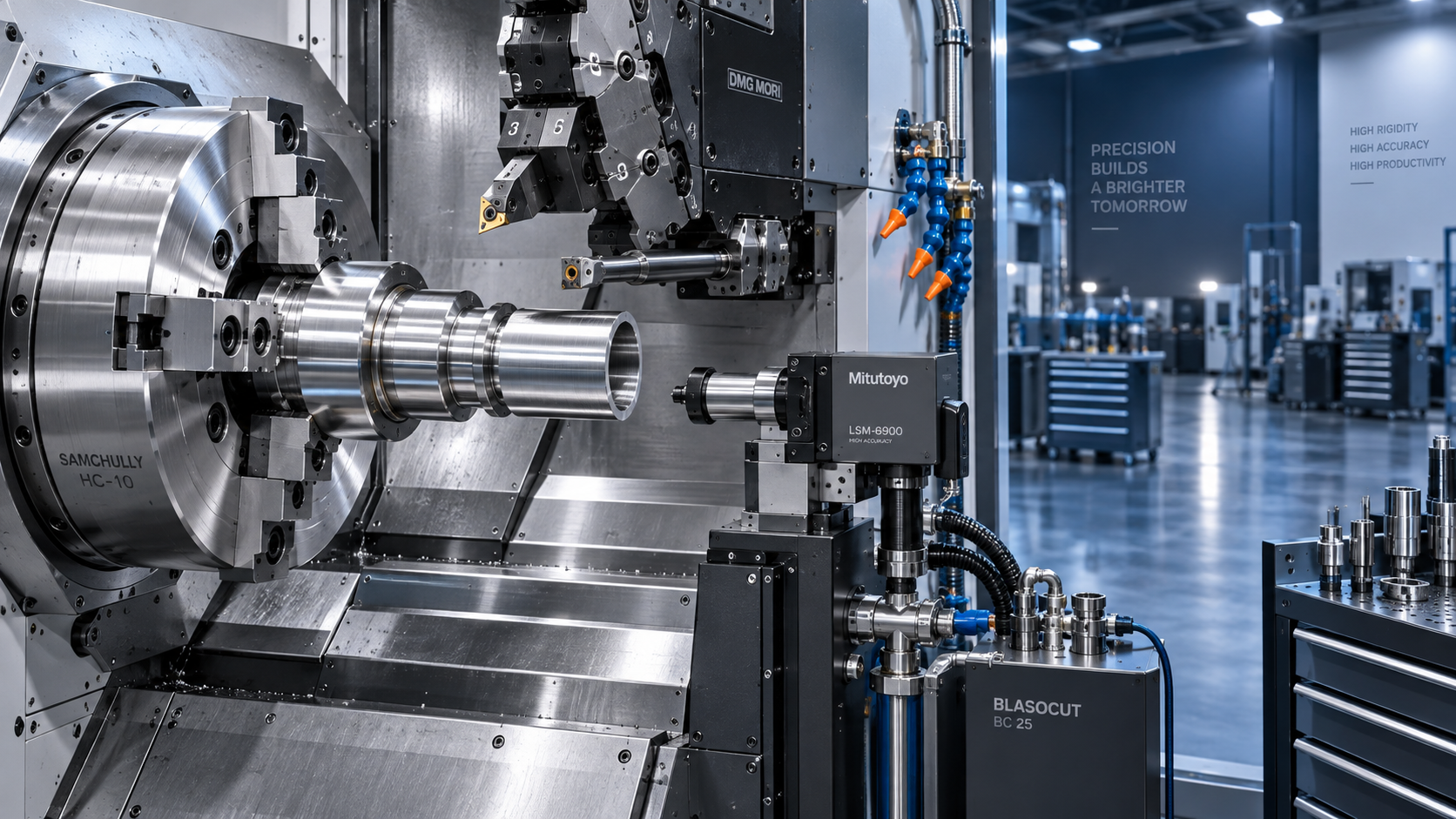
Smart manufacturing technology can shorten this feedback loop by linking in-process measurement, coordinate measuring machine results, vision inspection, torque verification, and statistical process control to the production record. The goal is not to inspect every possible characteristic at every station. It is to identify critical process signals that can warn the team when variation is moving toward an unacceptable condition.
For CNC applications, this may involve associating measurement trends with tool age, spindle condition, material lot, fixture identity, program version, coolant state, or ambient conditions where relevant. When a trend is detected, the system should support a defined response: verify the tool, inspect the fixture, hold a limited quantity, adjust an offset under approved rules, or escalate to process engineering. A dashboard with no escalation path simply makes variation more visible.
Automated quality data also requires governance. Measurement systems must be calibrated, master data must be controlled, and digital records must reflect the actual product configuration. If operators routinely bypass data capture because terminals are slow or processes are unclear, the resulting analytics will be unreliable. Technology cannot compensate for weak process discipline.
Where implementation often goes wrong
The most common mistake is beginning with software selection before agreeing on the business problem. A platform may offer machine connectivity, digital work instructions, analytics, scheduling, and artificial intelligence features, but those capabilities do not establish the value case. A project manager needs a baseline: which losses are occurring, what capacity or quality risk they create, who owns the corrective action, and how improvement will be measured.
Another mistake is assuming that data from different equipment is inherently comparable. CNC machines from different generations, robot controllers, inspection equipment, and legacy PLCs may use different event definitions and communication methods. “Cycle complete,” “machine idle,” and “fault” can mean different things across assets. A connectivity project should include a clear event taxonomy and validation process before management uses the data for performance decisions.
Cybersecurity is also an operational requirement, not a separate IT concern. Connecting machine tools and production networks expands the attack surface and can create new points of failure. Segmented networks, role-based access, backup and recovery procedures, patching responsibilities, remote-access controls, and supplier access rules should be considered during architecture design. Requirements will vary by region, customer, and industry, so applicable cybersecurity obligations and standards should be confirmed for the specific operation 【待核实】.
Finally, avoid treating OEE as a tool for ranking people. When metrics are used primarily to assign blame, operators and supervisors may classify events defensively or avoid reporting emerging problems. The most productive OEE programs make losses visible so teams can remove obstacles. Accountability remains necessary, but it should focus on resolution ownership and process improvement.
A practical deployment path for project managers
A phased approach is generally more reliable than a factory-wide launch. Start with a line or cell where lost capacity has a measurable business consequence: delayed customer delivery, excessive overtime, repeat quality containment, constrained equipment, or a planned capital expenditure that might be deferred through better utilization.
- Establish the baseline. Confirm scheduled time, ideal cycle assumptions, planned stoppages, scrap treatment, and current data quality. Do not compare a new digital OEE number with an older manually calculated number without reconciling definitions.
- Select a constrained process. Prioritize equipment with repeatable production, identifiable loss patterns, and an operations team able to act on the information. A stable pilot is more instructive than the most complicated line in the plant.
- Define a small number of action-oriented use cases. Examples include reducing repeat tool-related stops, detecting cycle-time drift, improving changeover consistency, or connecting inspection trends to machining conditions.
- Assign decision rights. Specify who can stop production, change an offset, request maintenance, revise a standard cycle, or approve a process change. Data becomes useful only when response authority is clear.
- Validate before scaling. Review whether the pilot improved throughput, quality, schedule adherence, or maintenance planning in a way that can be verified. Then assess integration, training, and cybersecurity requirements for expansion.
The investment case should include more than the expected OEE percentage. Consider labor required for data maintenance, engineering time for process interpretation, integration with existing ERP, MES, quality, and maintenance systems, training requirements, vendor support, and the cost of production disruption during deployment. In some facilities, the best result may be a modest system that provides trustworthy visibility on critical equipment. In others, broader orchestration across flexible lines and automated material handling may be justified.
The next measure of maturity is decision speed
As factories add CNC automation, robotics, flexible manufacturing systems, and digital quality controls, the operational challenge shifts from collecting data to making timely, consistent decisions. The mature production line is not necessarily the one with the most connected devices. It is the one where a developing problem is detected early, understood in context, assigned to the right owner, and resolved before it reduces customer service or creates unnecessary cost.
For project managers, this is the practical test for Smart Manufacturing Technology for Industry 4.0. The technology should make OEE more actionable, not simply more visible. When it links machine behavior to production commitments, process quality, and maintenance decisions, it can help recover capacity from existing assets. When it produces isolated dashboards, poorly defined alarms, and untrusted metrics, it becomes another system that the shop floor learns to work around.
The decision to invest should therefore begin with a production constraint, a credible data foundation, and an operating model for response. Those three conditions matter more than the breadth of the platform or the sophistication of its marketing language.
Recommended for You
 Digital Manufacturing for Smart Factories: Connecting Legacy Machines to MESMachine Tool Industry Editorial Team
 How to Select a CNC Metal Lathe for Tight-Tolerance Shaft and Sleeve PartsCNC Machining Technology Center
 How to Select an Industrial Lathe for High-Volume Shaft ProductionMachine Tool Industry Editorial Team
 Selecting Machine Tools for Automotive Parts: Accuracy, Throughput, and AutomationMachine Tool Industry Editorial Team
 Industrial Machining: Selecting Processes for Tight-Tolerance Metal PartsCNC Machining Technology Center
 Manufacturing Technology Trends That Improve Throughput and Quality ControlManufacturing Market Research Center

Aris Katos
Future of Carbide Coatings
15+ years in precision manufacturing systems. Specialized in high-speed milling and aerospace grade alloy processing.
▶
Digital Manufacturing for Smart Factories: Connecting Legacy Machines to MESMachine Tool Industry Editorial Team▶
Selecting Machine Tools for Automotive Parts: Accuracy, Throughput, and AutomationMachine Tool Industry Editorial Team▶
Smart Manufacturing for Small Businesses: Where Automation Delivers the Fastest ROIMachine Tool Industry Editorial Team▶
How Smart Manufacturing Technology Improves OEE Across Industry 4.0 Production LinesMachine Tool Industry Editorial Team▶
How to Evaluate an Automation Line for Electronics Production Before InvestmentMachine Tool Industry Editorial Team
Mastering 5-Axis Workholding Strategies
Join our technical panel on Nov 15th to learn about reducing vibrations in thin-wall components.

Providing you with integrated sanding solutions
Before-sales and after-sales services
Comprehensive technical support