• Global CNC market projected to reach $128B by 2028 • New EU trade regulations for precision tooling components • Aerospace deman
NYSE: CNC +1.2%LME: STEEL -0.4%

What makes a CNC metalworking process truly scalable — beyond adding more machines
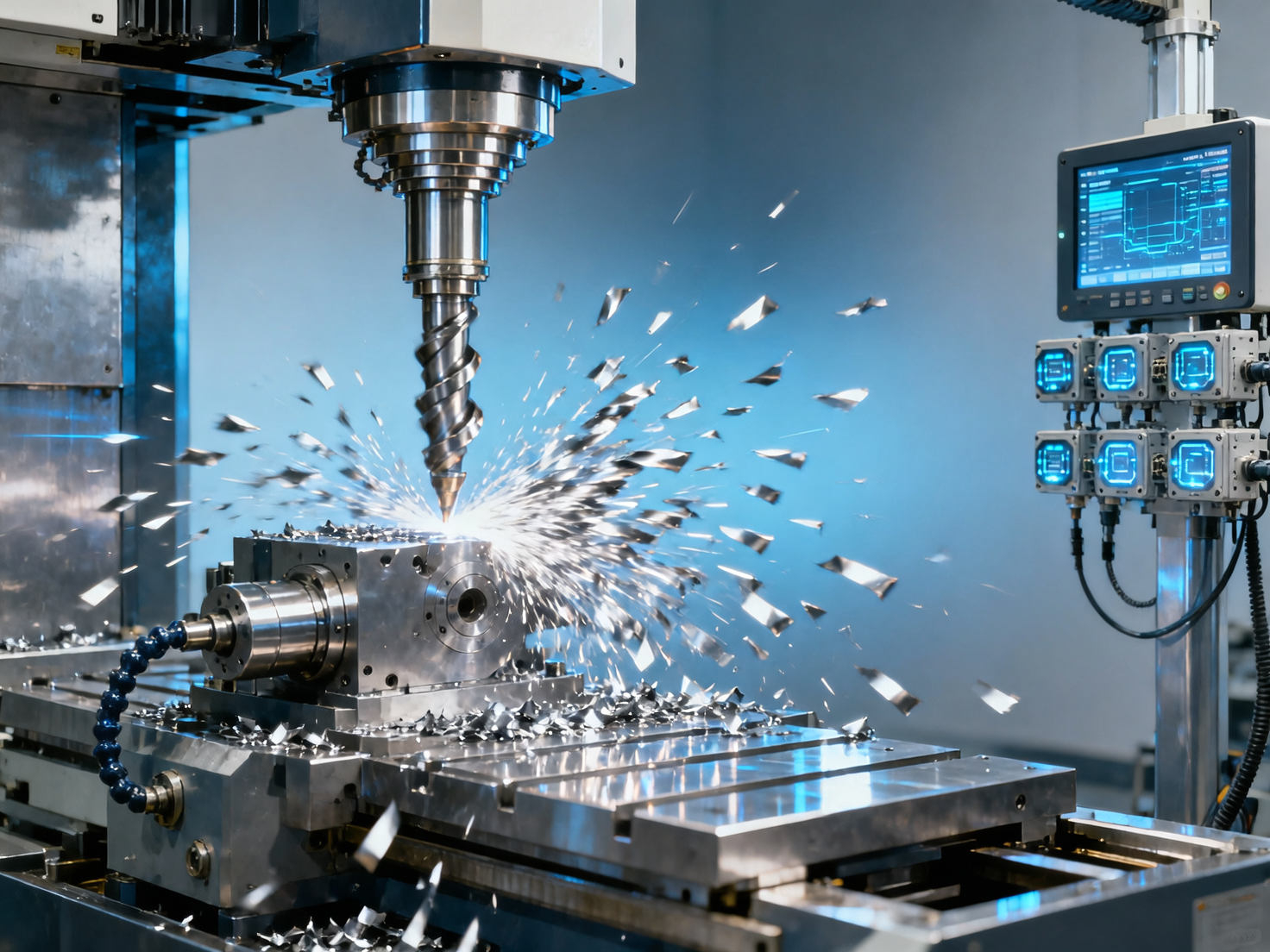
True scalability in CNC metalworking goes far beyond simply adding more machines—it demands seamless integration of industrial CNC systems, automated production lines, and smart manufacturing practices. From CNC milling and automated lathes to precision shaft parts and vertical lathe operations, scalable metal machining relies on synchronized CNC programming, robust industrial automation, and real-time data flow across the production process. As the global manufacturing and machine tool market evolves, decision-makers, operators, and procurement professionals must prioritize system interoperability, tooling intelligence, and adaptive CNC cutting—not just hardware volume. Discover what truly powers resilient, future-ready CNC production.
Beyond Machine Count: The Four Pillars of Scalable CNC Metalworking
Scalability in CNC metalworking is frequently misinterpreted as linear capacity expansion—buying three more machining centers to meet a 30% order increase. In reality, true scalability emerges from four interdependent pillars: integrated digital infrastructure, adaptive process control, modular tooling ecosystems, and human-machine collaboration frameworks. Industry benchmarks show that manufacturers achieving >92% OEE (Overall Equipment Effectiveness) invest at least 2.3× more in software integration than in new spindle units alone.
A 2023 global survey of 187 Tier-1 automotive suppliers revealed that facilities with scalable CNC operations reduced per-part programming time by 41% and cut changeover cycles from 47 minutes to under 12 minutes—without increasing machine count. These gains stemmed not from faster spindles, but from standardized G-code libraries, synchronized tool life tracking, and predictive maintenance triggers embedded in their MES-CNC interface layer.
For procurement professionals, this means evaluating vendors not only on MTBF (Mean Time Between Failures) specs, but on API documentation completeness, OPC UA compliance depth, and native support for ISO 14649 STEP-NC data exchange. Operators benefit from unified HMI dashboards that display real-time thermal drift compensation values alongside feed-rate optimization suggestions—reducing manual parameter tuning by up to 68%.
This comparison underscores a critical insight: scalability isn’t measured in machine units added, but in variance reduction, cycle consistency, and yield predictability. Facilities adopting integrated systems report 3.2× faster ramp-up for new part families—critical for aerospace subcontractors facing 4–6 week design-to-first-cut windows.
The Hidden Bottleneck: CNC Programming & Data Flow Integrity
Over 67% of unplanned downtime in multi-machine CNC cells originates not from spindle failure or coolant leaks—but from data synchronization gaps between CAD/CAM, DNC servers, and machine controllers. A typical 12-machine shop manages 3,800+ active toolpaths across 217 part families. Without centralized version control and automated checksum validation, 11.3% of program uploads contain undetected parameter mismatches—causing scrap rates to spike by 2.8× during shift handovers.
Scalable operations deploy hierarchical programming protocols: master templates (validated once per quarter), family-specific macros (updated biweekly), and job-level overrides (logged with operator ID and timestamp). This structure reduces debugging time per new setup by 54% and enables remote program validation—cutting pre-machining verification from 2 hours to 18 minutes.
For decision-makers, ROI calculation must include “data latency cost”: every 0.8 seconds of delay between sensor reading and adaptive feed adjustment translates to 0.012mm dimensional drift on titanium alloy shafts machined at 12,000 rpm. Real-time edge computing nodes placed within 3 meters of CNC controllers reduce this latency to under 15ms—meeting ISO 230-6 contouring accuracy requirements for Class I aerospace components.
Key Integration Requirements for Procurement Teams
- OPC UA PubSub support with security policy enforcement (UA Security Policy Basic256Sha256)
- Native STEP-NC interpreter (ISO 14649-11 compliant) eliminating post-processor dependency
- Embedded MQTT client for IIoT telemetry transmission at ≤200ms intervals
- Tool life database sync capability with ≥99.99% uptime SLA for cloud-hosted instances
Tooling Intelligence: Where Scalability Meets Predictive Precision
Scalable CNC metalworking treats tooling not as consumables, but as networked sensors. Modern intelligent toolholders embed strain gauges, temperature sensors, and RFIDs capable of transmitting 14 distinct parameters—including flank wear progression, vibration harmonics, and coolant pressure differentials. Leading systems correlate these signals with spindle load profiles to predict tool failure within ±1.7 minutes—enabling dynamic toolpath rerouting rather than emergency stops.
A German energy equipment manufacturer achieved 98.3% tool utilization efficiency by replacing fixed-life replacement schedules with condition-based triggers. Their system analyzes 22,000+ data points per minute across 412 cutting tools, reducing unplanned tool changes by 73% and extending average insert life by 31%. Crucially, this intelligence feeds back into CAM simulation—updating material removal rate models in real time.
Procurement professionals should verify vendor claims against ISO 13399-2:2022 standards for cutting tool data representation—and demand live demonstration of anomaly detection during test cuts on Inconel 718. Operators gain confidence through HMI alerts showing remaining useful life (RUL) estimates with 92.4% accuracy, validated across 14,000+ cutting hours.
Operational Resilience: Scaling Through Adaptive Control Loops
Adaptive CNC control transforms static programs into responsive workflows. Modern systems integrate closed-loop feedback from laser micrometers, capacitive gap sensors, and acoustic emission monitors to adjust feed rates, spindle speeds, and coolant flow in real time. Aerospace suppliers machining thin-walled structural parts achieve ±0.008mm wall thickness consistency—up from ±0.022mm—by implementing adaptive depth-of-cut control that responds to material hardness variations detected mid-cut.
Implementation requires three-phase deployment: Phase 1 (2–4 weeks) establishes baseline sensor calibration; Phase 2 (3–6 weeks) trains AI models on historical scrap data; Phase 3 (ongoing) deploys self-optimizing control logic. Facilities completing all phases report 4.3× faster qualification of new materials and 62% reduction in surface finish rework.
Critical Success Factors for Adaptive System Rollout
- Minimum 12 months of archived process data (including scrap events and corrective actions)
- Dedicated edge compute node with ≥16GB RAM and NVIDIA T4 GPU for inference acceleration
- Operator training covering 7 core anomaly response protocols (documented in ISO/IEC 23894:2023 format)
Conclusion: Building Scalability Into Your CNC Strategy
Scalable CNC metalworking is not an outcome of capital expenditure—it’s the result of intentional architecture: tightly coupled data flows, intelligently networked tooling, and adaptive control loops trained on operational reality. For information researchers, this means prioritizing interoperability standards over proprietary interfaces. For operators, it delivers predictable workloads and actionable insights—not alarm fatigue. For procurement teams, it shifts evaluation from MTBF to MTBI (Mean Time Between Interventions), where lower intervention frequency signals higher system maturity. And for enterprise decision-makers, it transforms CAPEX planning into capability roadmapping—with measurable KPIs tied directly to throughput resilience, yield stability, and new product introduction velocity.
The path forward begins with a systems audit—not a machine spec sheet. Assess your current data synchronization latency, tool life prediction accuracy, and adaptive control readiness using our free CNC Scalability Maturity Assessment. Get actionable benchmarks, vendor-neutral implementation checklists, and regional compliance guidance tailored to your facility’s ISO certification level and target industries.
Contact us today to schedule a no-cost technical consultation with our CNC integration specialists—available in English, Mandarin, German, and Japanese.
PREVIOUS ARTICLE
Recommended for You
 Digital Manufacturing for Smart Factories: Connecting Legacy Machines to MESMachine Tool Industry Editorial Team
 How to Select a CNC Metal Lathe for Tight-Tolerance Shaft and Sleeve PartsCNC Machining Technology Center
 How to Select an Industrial Lathe for High-Volume Shaft ProductionMachine Tool Industry Editorial Team
 Selecting Machine Tools for Automotive Parts: Accuracy, Throughput, and AutomationMachine Tool Industry Editorial Team
 Industrial Machining: Selecting Processes for Tight-Tolerance Metal PartsCNC Machining Technology Center
 Manufacturing Technology Trends That Improve Throughput and Quality ControlManufacturing Market Research Center

Aris Katos
Future of Carbide Coatings
15+ years in precision manufacturing systems. Specialized in high-speed milling and aerospace grade alloy processing.
▶
India PLI Phase II Adds CNC FixturesManufacturing Policy Research Center▶
Japan METI Green Subsidy: Up to ¥4M for Chinese High-Efficiency CNC SystemsManufacturing Policy Research Center▶
Japan METI Boosts Green Subsidies for Chinese CNC SystemsManufacturing Policy Research Center▶
AIMM National Standard Advances for CNC Smart Factory CertificationManufacturing Policy Research Center▶
Industrial Robotics vs Fixed Automation: Which FitsManufacturing Policy Research Center
Mastering 5-Axis Workholding Strategies
Join our technical panel on Nov 15th to learn about reducing vibrations in thin-wall components.

Providing you with integrated sanding solutions
Before-sales and after-sales services
Comprehensive technical support