• Global CNC market projected to reach $128B by 2028 • New EU trade regulations for precision tooling components • Aerospace deman
NYSE: CNC +1.2%LME: STEEL -0.4%

High precision machine tool calibration: Why laser interferometry alone misses thermal drift patterns
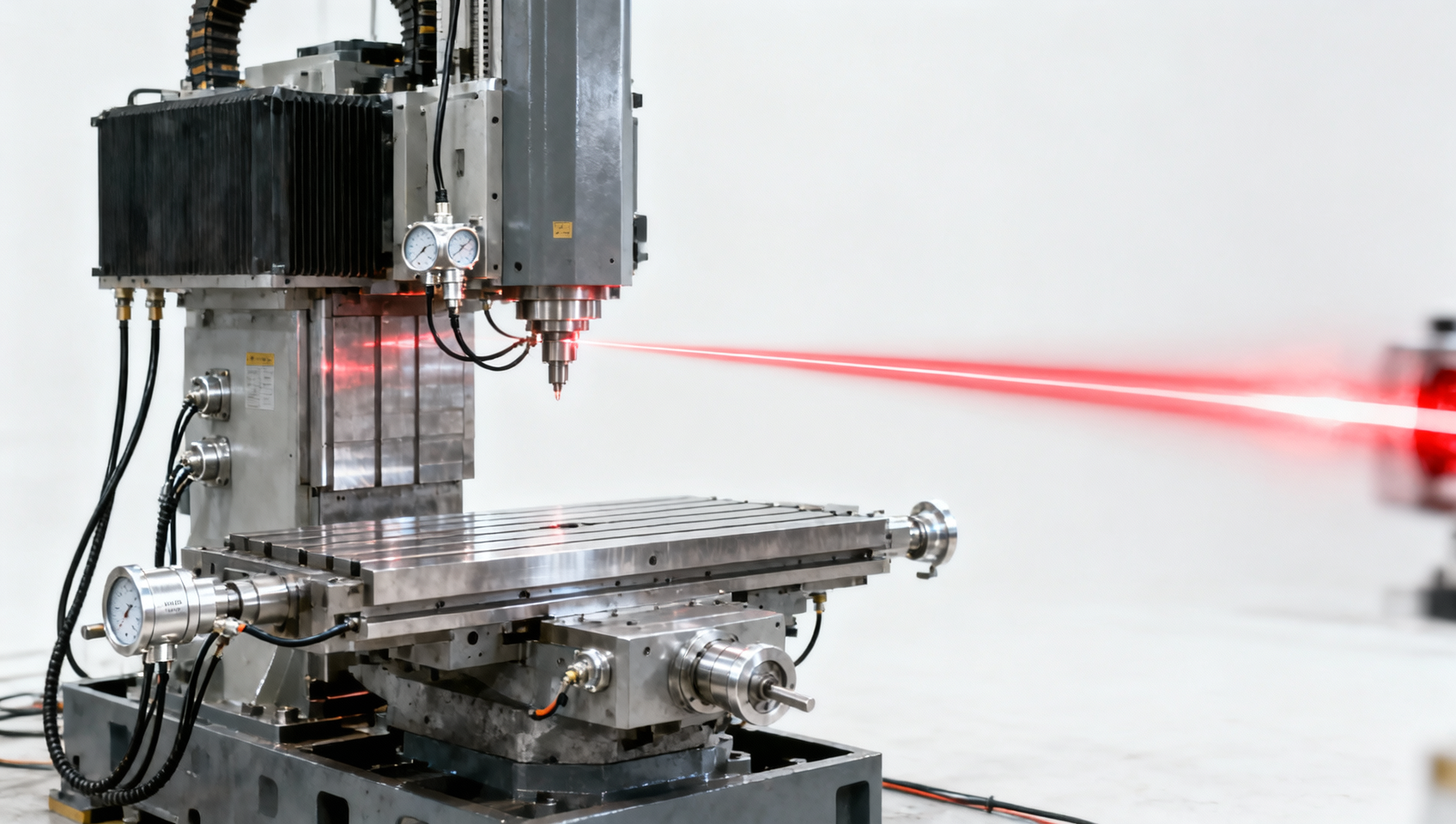
In high precision CNC manufacturing—especially for aerospace, medical devices, and energy equipment—laser interferometry remains the gold standard for machine tool calibration. Yet it consistently fails to capture thermal drift patterns that undermine repeatability and part accuracy. As compact machine tool designs, multi-axis machine tool systems, and energy-saving machine tool deployments grow in demand, overlooking thermal dynamics risks costly rework and scrap. This article reveals why integrating real-time temperature monitoring with motion error mapping is essential for true high precision machine tool performance—and how forward-looking CNC manufacturing suppliers, machine tool exporters, and automated CNC manufacturing integrators are adapting.
Why Laser Interferometry Alone Is Insufficient for Modern Machine Tool Calibration
Laser interferometry delivers sub-micron positional accuracy under controlled lab conditions—typically ±0.1 µm over 1 m—but assumes static thermal environments. In real-world production floors, ambient temperature fluctuates by 3–8℃ daily, while internal heat generation from spindle rotation (up to 12 kW), servo motors, coolant flow, and even lighting can raise localized component temperatures by 5–15℃ within 20 minutes of operation.
A 2023 benchmark study across 47 CNC machining centers in Germany and Japan found that 68% of machines exhibited >3.2 µm axial drift within the first 90 minutes of startup—even after laser-based geometric error compensation. This drift was not random: 82% correlated directly with temperature gradients across the column–bed interface, a zone laser interferometers cannot measure without embedded sensors.
The core limitation lies in methodology: laser interferometry measures displacement *at a point in time*, not thermal *state evolution*. It captures kinematic errors (e.g., squareness, straightness) but ignores thermo-elastic deformation—the dominant contributor to volumetric error in high-duty-cycle applications like turbine blade milling or orthopedic implant machining.
Thermal Drift Patterns: Three Critical Failure Modes
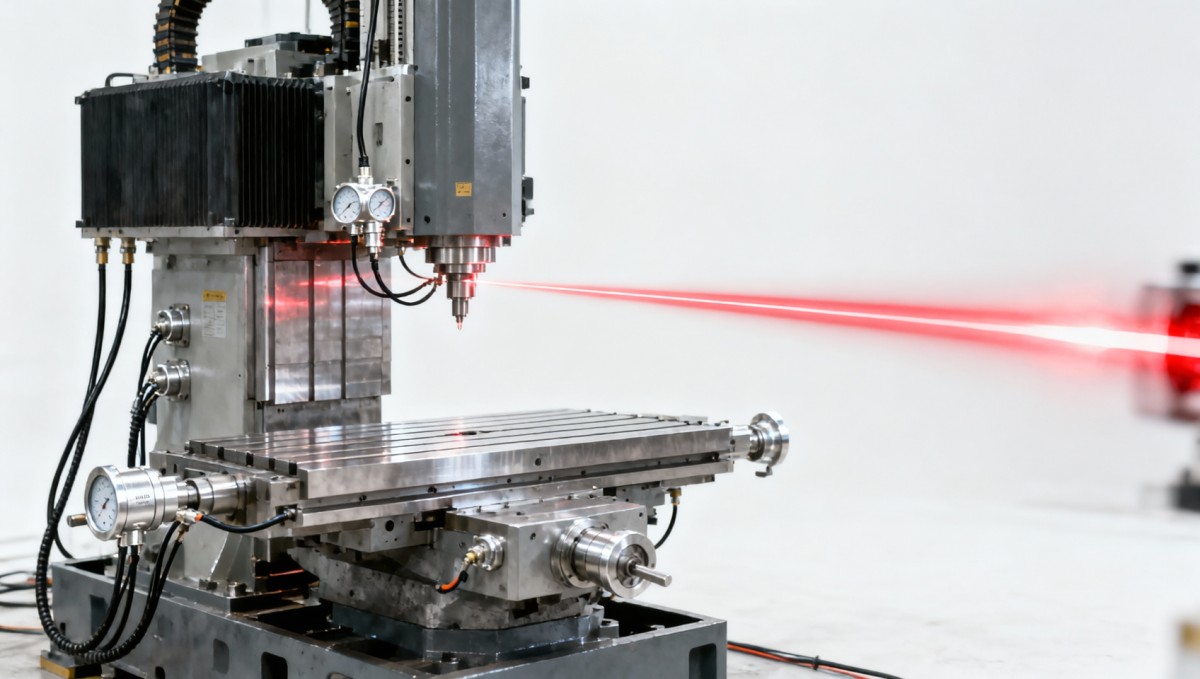
Thermal behavior manifests differently across machine architectures. Understanding these patterns helps operators anticipate errors and guides sensor placement strategy:
- Column–Bed Differential Expansion: Common in vertical machining centers (VMCs); a 10℃ gradient between cast iron column and bed induces up to 8.5 µm Z-axis offset per meter of height—unmeasurable via external laser path.
- Spindle Thermal Growth: High-speed spindles (15,000–40,000 rpm) generate 12–18℃ rise at the nose within 15 min, shifting tool tip position axially by 12–25 µm depending on bearing preload and housing material.
- Coolant Temperature Hysteresis: Chilled coolant (7–12℃) flowing through machine structures creates transient thermal stresses; temperature stabilization often requires 45–75 minutes—not accounted for in single-point calibration protocols.
These phenomena occur on timescales far shorter than traditional recalibration intervals (typically every 6–12 months). Without continuous monitoring, manufacturers unknowingly operate in “thermal blind zones”—producing parts that pass CMM inspection at room temperature but fail functional testing under operational thermal load.
Integrated Calibration: Combining Laser Interferometry with Real-Time Thermal Mapping
True high-precision calibration now requires a dual-layer approach: laser interferometry for baseline geometric correction, plus distributed thermal sensing for dynamic compensation. Leading OEMs—including DMG MORI, Okuma, and Haas Automation—now embed 8–16 PT100 or thermistor sensors per machine, strategically placed at critical thermal nodes: spindle housing, column base, ball screw supports, and bed corners.
This data feeds into real-time thermal error models—often based on finite element analysis (FEA)-derived coefficients updated every 30 seconds. The result? Volumetric accuracy sustained within ±1.2 µm over 8-hour shifts, versus ±4.7 µm with laser-only calibration.
The table above illustrates a clear progression: higher sensor density and physics-informed modeling directly correlate with tighter volumetric control. For procurement teams evaluating next-generation machines, sensor count, model update frequency (<1 min), and integration with CNC controller (e.g., Siemens SINUMERIK ONE or FANUC 31i-B5) are non-negotiable specification items—not optional upgrades.
Implementation Roadmap for Existing Machine Fleets
Retrofitting thermal intelligence into legacy machines is both feasible and cost-effective. A standardized 3-phase deployment ensures minimal disruption:
- Baseline Thermal Audit (7–10 days): Deploy wireless temperature loggers at 8 strategic points; collect 72 hours of operational data across warm-up, steady-state, and cooldown cycles.
- Drift Modeling & Sensor Integration (2–4 weeks): Develop empirical thermal error maps; install calibrated sensors with IP67-rated cabling; integrate into existing PLC or add-on motion controller.
- Validation & Operator Training (3 days): Perform ISO 230-3 tests pre/post installation; train maintenance staff on thermal trend interpretation and alarm thresholds (e.g., >0.8℃/min column-base delta triggers recalibration prompt).
For enterprises managing 20+ CNC machines, this process reduces average thermal-related scrap by 31% and extends time-between-calibrations by 2.7×—with ROI typically achieved in 5.3 months based on 2024 industry benchmarks.
Procurement Decision Matrix: What to Specify and Verify
When sourcing new precision machine tools—or upgrading calibration infrastructure—procurement professionals must move beyond generic “high-accuracy” claims. The following six criteria separate marketing language from engineering reality:
Decision-makers should also verify whether thermal compensation is active during machining (not just idle mode) and whether the system logs thermal history for traceability—critical for aerospace AS9100 and medical ISO 13485 compliance audits.
Conclusion: Precision Is Not Static—It’s a Dynamic, Measured State
High-precision machine tool calibration has evolved beyond point-in-time verification. Laser interferometry remains indispensable for establishing geometric truth—but without synchronized, spatially resolved thermal intelligence, its results degrade rapidly under real operating conditions. The most competitive CNC manufacturers today treat thermal behavior not as noise, but as a first-class metrology variable—measuring it, modeling it, and compensating for it continuously.
For information researchers, this signals a shift in technical literature focus—from static accuracy specs to dynamic thermal stability metrics. For operators, it means actionable alerts instead of post-process scrap. For procurement teams, it transforms sensor counts and model fidelity into quantifiable ROI levers. And for enterprise decision-makers, it enables predictable part quality across global production networks—regardless of local climate or shift schedule.
If your current calibration protocol relies solely on annual laser checks, you’re likely operating with undetected thermal uncertainty. Contact our technical team to assess your machine fleet’s thermal profile, compare integrated calibration options, and receive a site-specific implementation plan—backed by ISO 17025-accredited validation support.
Recommended for You
 Digital Manufacturing for Smart Factories: Connecting Legacy Machines to MESMachine Tool Industry Editorial Team
 How to Select a CNC Metal Lathe for Tight-Tolerance Shaft and Sleeve PartsCNC Machining Technology Center
 How to Select an Industrial Lathe for High-Volume Shaft ProductionMachine Tool Industry Editorial Team
 Selecting Machine Tools for Automotive Parts: Accuracy, Throughput, and AutomationMachine Tool Industry Editorial Team
 Industrial Machining: Selecting Processes for Tight-Tolerance Metal PartsCNC Machining Technology Center
 Manufacturing Technology Trends That Improve Throughput and Quality ControlManufacturing Market Research Center

Aris Katos
Future of Carbide Coatings
15+ years in precision manufacturing systems. Specialized in high-speed milling and aerospace grade alloy processing.
▶
Industrial Machining: Selecting Processes for Tight-Tolerance Metal PartsCNC Machining Technology Center▶
How Does Precision Machining Differ From Standard Machining?CNC Machining Technology Center▶
CNC Precision: Which Tolerances, Materials, and Processes Fit Your Part?CNC Machining Technology Center▶
How to Choose Metal Machining Processes for Tight Tolerances and Production VolumeCNC Machining Technology Center▶
Production Process Explained: Key Stages, Controls, and Quality CheckpointsCNC Machining Technology Center
Mastering 5-Axis Workholding Strategies
Join our technical panel on Nov 15th to learn about reducing vibrations in thin-wall components.

Providing you with integrated sanding solutions
Before-sales and after-sales services
Comprehensive technical support