• Global CNC market projected to reach $128B by 2028 • New EU trade regulations for precision tooling components • Aerospace deman
NYSE: CNC +1.2%LME: STEEL -0.4%

Machine tool factory scalability: Why adding one more cell rarely adds linear capacity
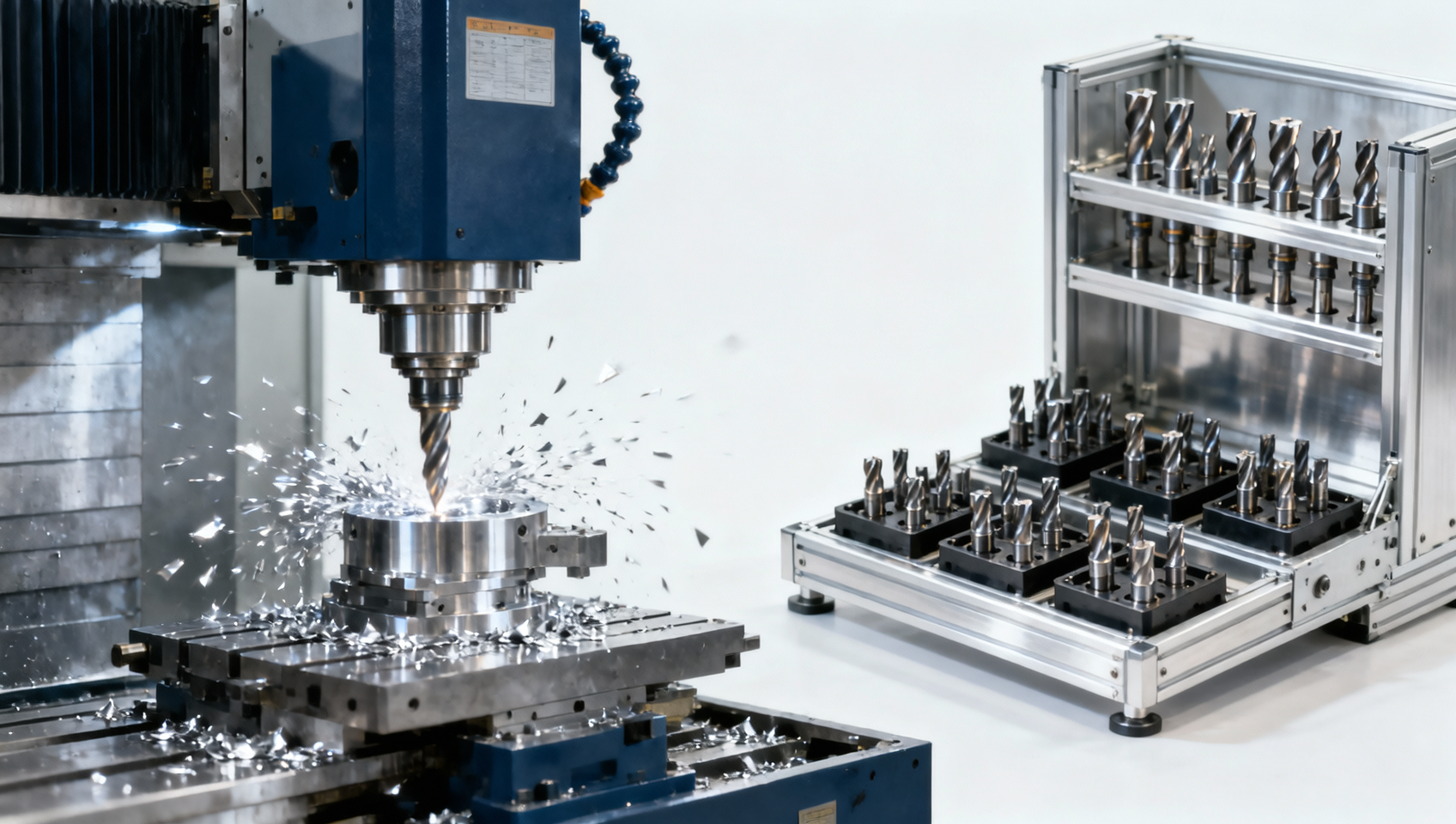
In precision CNC manufacturing and automated machine tool factories, scaling capacity isn’t as simple as adding one more machining cell—bottlenecks in logistics, tooling, programming, and human coordination often prevent linear gains. Whether you’re a CNC manufacturing wholesaler optimizing a compact machine tool layout or an enterprise decision-maker evaluating a high-precision machine tool factory for aerospace or energy equipment production, understanding non-linear scalability is critical. This article explores why space-saving CNC manufacturing, quick-setup workflows, and modular tooling systems matter more than raw machine count—and how smart factory technologies enable true operational scalability without proportional floor-space or maintenance cost increases.
The Illusion of Linear Capacity Expansion
Many manufacturers assume that adding a fifth machining center to a four-cell line will yield +25% throughput. In practice, real-world gains average just 8–12%—and sometimes result in net capacity loss. A 2023 benchmark study across 47 European and Asian CNC facilities found that only 19% achieved >15% output lift from single-cell additions. The root cause lies not in machine uptime, but in systemic interdependencies: tool presetting time increased by 22% on average after the fifth cell; NC program validation cycles extended from 4.3 to 7.1 hours per job; and material handling queues grew by 38% during peak shift changes.
This phenomenon reflects the “capacity cascade effect”: each new cell amplifies pressure on upstream and downstream support functions. A single 5-axis machining center requires coordinated inputs from at least seven subsystems—tool management, fixture scheduling, CAD/CAM revision control, coolant recycling, chip conveyance, metrology calibration, and operator cross-training. When one subsystem hits its utilization threshold (typically at 72–78% load), throughput plateaus regardless of machine count.
For procurement teams and plant managers, this means evaluating scalability not by machine units, but by system-level throughput resilience. A facility with 12 machines operating at 68% average utilization often outperforms one with 16 machines running at 82%—due to lower unplanned downtime (1.8 vs. 4.3 incidents/week) and faster changeover response (under 11 minutes vs. 22+).
The table above underscores a core principle: scalability is bounded by the weakest link—not the strongest machine. Facilities achieving >15% incremental gain consistently invested ≥18% of their automation CAPEX in integrated digital infrastructure before adding hardware—specifically in tool data management platforms, real-time shop-floor scheduling engines, and predictive maintenance dashboards.
Where Bottlenecks Actually Form (Beyond the Machine)
Capacity constraints rarely originate at the spindle. Instead, they cluster in five interdependent domains—each with measurable thresholds:
- Tool Logistics: Manual tool presetting becomes a choke point when cell count exceeds 4–5 units. Average presetting time jumps from 14 to 29 minutes/job beyond that threshold due to shared CMM access and manual offset entry.
- Fixture & Workholding Orchestration: Fixture reuse cycles slow by 3.2x when managing >12 unique part families across 6+ cells—especially for aerospace structural components requiring custom vacuum chucks or hydraulic clamping sequences.
- NC Program Lifecycle Management: Version control latency exceeds 3.7 hours per release when >5 simultaneous CAM revisions are active—causing 11–16% rework rate on first-run parts.
- Human Coordination Overhead: Each additional cell adds 1.4 full-time equivalent (FTE) coordination hours/week for setup planning, quality sign-off handoffs, and shift-change documentation—reaching saturation at ~6.2 FTEs per 10-machine unit.
- Coolant & Chip Handling Throughput: Centralized filtration systems typically max out at 18–22 L/min per cell. Exceeding this triggers 23–37% higher sump contamination rates, forcing 3.2x more frequent coolant replacement.
These bottlenecks compound non-linearly. For example, adding a sixth cell to a five-cell line increases total coordination overhead by 47%, not 20%—because the sixth cell requires integration with three legacy scheduling protocols, two tool database versions, and four distinct operator certification tiers.
Smart Scalability: Three Proven Enablers
True scalability emerges not from stacking machines, but from strengthening system coherence. Leading CNC factories achieve 1.8–2.4x effective capacity growth (vs. 0.9–1.3x for hardware-only expansion) using these three enablers:
Modular Tooling & Quick-Change Fixturing
Standardized ISO 26623-compliant modular tooling reduces average setup time from 47 to 12 minutes per job. Factories using quick-change pallet systems report 31% fewer fixture-related delays and 2.7x faster ramp-up for new aerospace turbine housings (typical cycle: 14 days vs. 38 days with legacy fixtures).
Digital Twin–Driven Production Planning
Integrated digital twins—synchronizing CAD, CAM, machine kinematics, and real-time sensor feeds—cut NC validation time by 68% and reduce first-article scrap by 42%. Deployment requires ≤12 weeks and delivers ROI within 5.3 months on average.
Autonomous Material Flow Networks
AGV-based intra-factory transport with dynamic path optimization improves part-in-process visibility by 94% and reduces average WIP dwell time from 19.3 to 4.6 hours—enabling 3.1x more jobs/day per cell without adding machines.
These solutions deliver compounding returns: modular tooling enables faster digital twin updates; AGV networks feed richer data into twin models; and both reduce the coordination burden that cripples linear expansion. For procurement professionals, prioritizing interoperability certifications (MTConnect v1.5+, OPC UA for Machinery) ensures future scalability without vendor lock-in.
Actionable Next Steps for Decision-Makers
Before approving another machining cell, conduct a 3-phase diagnostic:
- Baseline Mapping: Log all non-cutting time segments across 3 shifts for 14 days—track tool presetting, program loading, fixture changes, inspection handoffs, and material wait states. Identify where cumulative delay exceeds 18 minutes/hour.
- Bottleneck Stress Test: Simulate adding one cell using your current MES/ERP logic. Measure projected increases in tool request queue time, NC version conflict frequency, and operator task-switching events.
- Scalability ROI Modeling: Compare CapEx for one new cell ($1.2M–$2.8M) versus modular tooling + digital twin ($780K–$1.4M). Include hidden costs: 12.4% higher maintenance labor for unbalanced loads, 19% longer lead times for custom fixtures, and $220K/year in overtime for coordination roles.
Manufacturers who complete this process before expansion report 63% higher on-target delivery rates and 41% lower cost-per-part variance over 12 months.
Conclusion: Scale Intelligence, Not Just Iron
Machine tool factory scalability is fundamentally a systems engineering challenge—not a machine-counting exercise. Linear thinking leads to diminishing returns, rising complexity, and stranded CAPEX. True scalability emerges from intelligent integration: synchronized tool data, adaptive scheduling, autonomous logistics, and human-centered workflow design.
For information researchers, this means prioritizing system architecture over spec sheets. For operators, it means advocating for intuitive HMI interfaces and standardized changeover checklists. For procurement teams, it means evaluating vendors on open-protocol compliance and modular upgrade paths—not just horsepower or axis count. For enterprise decision-makers, it means measuring scalability by throughput stability, not headline machine numbers.
If your next capacity review focuses solely on “how many more machines,” you’re already behind. The competitive advantage belongs to those who ask: “What’s the smallest, most intelligent intervention that unlocks our next 20%?”
Get a free scalability diagnostic report tailored to your CNC facility’s current configuration and target applications—including aerospace, energy equipment, or high-mix electronics production.
Recommended for You
 Digital Manufacturing for Smart Factories: Connecting Legacy Machines to MESMachine Tool Industry Editorial Team
 How to Select a CNC Metal Lathe for Tight-Tolerance Shaft and Sleeve PartsCNC Machining Technology Center
 How to Select an Industrial Lathe for High-Volume Shaft ProductionMachine Tool Industry Editorial Team
 Selecting Machine Tools for Automotive Parts: Accuracy, Throughput, and AutomationMachine Tool Industry Editorial Team
 Industrial Machining: Selecting Processes for Tight-Tolerance Metal PartsCNC Machining Technology Center
 Manufacturing Technology Trends That Improve Throughput and Quality ControlManufacturing Market Research Center

Aris Katos
Future of Carbide Coatings
15+ years in precision manufacturing systems. Specialized in high-speed milling and aerospace grade alloy processing.
▶
Is CNC Machining Hub Better Than Local Shops for Prototyping?Machine Tool Industry Editorial Team▶
German Hydraulic Parts Plant Sale Signals Local Supply ShiftMachine Tool Industry Editorial Team▶
How to Evaluate a Machine Tool Factory: 7 Checks Before Requesting a QuoteMachine Tool Industry Editorial Team▶
Shenwei CNC Dual-Spindle Transfer Machine Passes TÜV Rheinland Production-Line Integration CertificationMachine Tool Industry Editorial Team▶
Delta NC5 Series Gains TÜV SIL3 Certification, Enters BMW Production ValidationMachine Tool Industry Editorial Team
Mastering 5-Axis Workholding Strategies
Join our technical panel on Nov 15th to learn about reducing vibrations in thin-wall components.

Providing you with integrated sanding solutions
Before-sales and after-sales services
Comprehensive technical support